What the app does
Sandhya Vandanam is a pañcāṅga, a saṃkalpa, and a record of your practice. All three work from the one thing that decides everything else: where you are standing.
Sandhya Vandanam is a pañcāṅga, a saṃkalpa, and a record of your practice. All three work from the one thing that decides everything else: where you are standing.
Most pañcāṅgas name the tithi, nakṣatra, yoga and karaṇa current at sunrise and leave it there. But a day rarely has one of each. Tithi ends at 01:31 tomorrow, nakṣatra at 18:22 today, and two or three karaṇas come and go before nightfall. This app carries all of them, advances to the one current as the hours pass, and marks with a +1 anything that runs past midnight — so a tithi ending at 02:15 tomorrow never reads as 02:15 today.
The three sandhyās each have three grades, and they are defined by the sky rather than the clock. The app computes the uttama, madhyama and adhama windows for your own latitude and the day's own sunrise, so the question is not merely whether it is time but which time it is.
Sunrise to sunset in eight equal parts, and sunset to the next sunrise in eight more — sixteen choghadiya, each named and marked auspicious, neutral or to be avoided, with the one running now picked out. The card opens on whichever half you are in. Because the parts are eighths of your own daylight rather than fixed clock times, they move with your latitude and with the season.
Brahma muhūrta, abhijit, and the periods to avoid — rāhukālam, yamagaṇḍam, gulika — each computed from sunrise where you are standing, rather than read off a table printed for somewhere else. That distinction is not cosmetic: sunrise moves by about twenty-five minutes between Delhi and the Karnataka coast, and every one of these windows moves with it.
Notifications for each sandhyā, set against your own windows. They shift through the year as your sunrise does, without your touching anything.
श्रीशैलस्य वायव्य प्रदेशे, कृष्णा गोदावर्योः मध्यदेशे, भाग्यनगरे
The saṃkalpa is a statement of fact — the dvīpa, the varṣa, the khaṇḍa, the quadrant you occupy from your anchor kṣetra, the rivers you stand between, the sea you stand beside, your city, and then the year, month, pakṣa, tithi, vāra, nakṣatra, yoga and karaṇa. Recited from a template learnt in another town, most of it is simply untrue of the person saying it.
So the app derives it. The rivers are real courses, not latitudes: it knows Varanasi stands on the Ganga's west bank, Kurukshetra between the Yamunā and the lost Sarasvatī, and Peshawar in the north-west quadrant of Śrīśailam — because it measures to the nearest point on the actual course. The Sanskrit is declined properly, so a place becomes भाग्यनगरे, तक्षशिलायाम्, सिंहपुरे and not a name with a suffix stuck on.
Read it in your own script, in Devanāgarī, or in Roman. Add your name and gotram and they take their place in it. Copy or share the whole thing.
A map of every place the app can name in Sanskrit, with the rivers of the saṃkalpa drawn along their true courses. Tap a place to see its Indic name and the form actually recited — कानपुरे सन्ध्यावन्दनं करिष्ये. If your town has a name the app does not carry, send it in from there, with its source.
Mark prātaḥ, mādhyāhnika and sāyaṃ as you keep them. If you keep only one or two, tell the app which and it will track and remind you for those rather than nagging about the rest.
An on-screen counter for the Gāyatrī, with haptic feedback so you are not watching the screen while you count. The total is kept with the day's record.
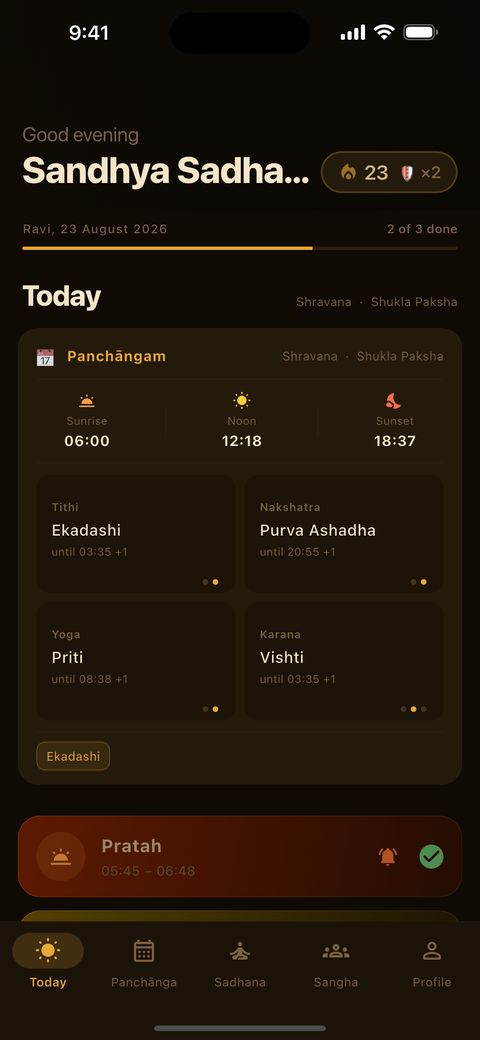
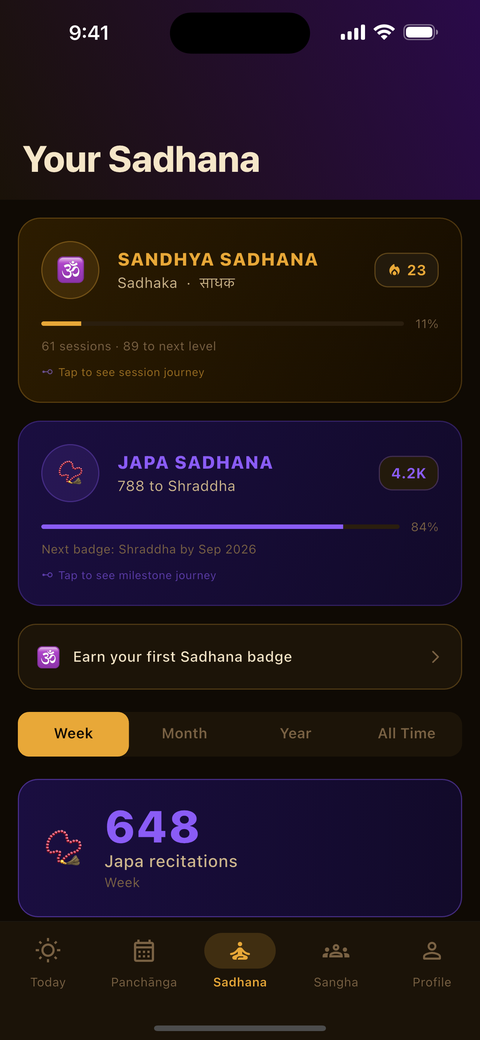
A streak that survives reinstalling the app, a calendar of what you kept and what you missed, weekly, monthly and yearly figures, and badges at the milestones. The purpose of a nitya karma is that it is unbroken, and a streak is simply an honest picture of whether it has been.
Create a group, share the invite code, and up to twenty-five people keep the practice within sight of one another. Each member sees the others' names and how many sandhyās they have kept. Nothing else is shared — not your location, not your saṃkalpa, not your japa counts.
It is worth being plain about why this exists. A daily obligation kept entirely in private is the easiest kind to let go, and the hardest to resume. A family, a paṭhaśālā or a few friends holding each other loosely to account is an old arrangement, and it works.
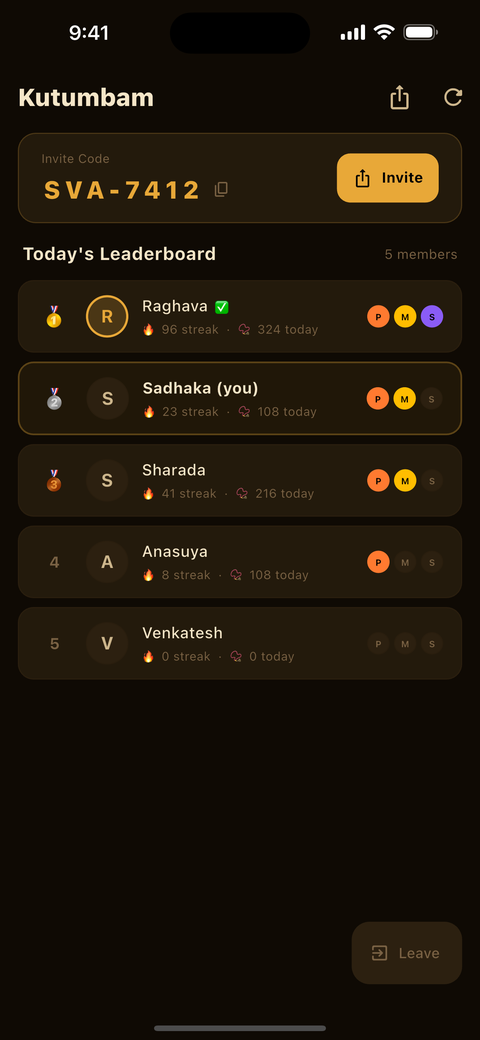
Sangha needs an account, because it has to survive reinstalling the app. Everything else on this page — the pañcāṅga, the saṃkalpa, the timings, the Atlas — works with no account at all.
Tithi, nakṣatra, yoga, karaṇa and the festival days are read from what Śrī Śāradā Pīṭham publishes rather than computed independently and then disagreeing with the Peetham. Where a date falls outside the published range the app falls back to a Sūrya-Siddhānta calculation and tells you so. Where authorities differ, it follows Sringeri.
The app and the pañcāṅga in your own language, and the saṃkalpa in your own script.
Every calculation runs on the device. Your coordinates are never transmitted — the single exception being a place suggestion, which you choose to send. See the privacy policy, which is written from what the code actually does.
Both, following your device or set by hand.
In beta on iOS while the store listing is prepared, with Android to follow.