Writing
On sandhyāvandanam, and on what went into building the app. Everything quoted here is listed on the sources page.
On sandhyāvandanam, and on what went into building the app. Everything quoted here is listed on the sources page.
Every conversation about daily sandhyāvandanam arrives at the same place. Not doubt about whether it is worth doing — almost nobody argues that — but the plain report that there is no time.
The question was put to the Jagadguru of Sringeri in almost those words: circumstances have changed, the pace of life is different, show us an easier substitute. The answer, recorded in the Q&A compiled by the Sandhyāvandana Abhyasana Śikṣaṇa Samiti, does not soften:
“Such methods are not sanctioned by śāstra. There is time every day to watch television, time for a morning walk, time to read the newspaper, time to chat with friends — hours together for all of these. And no time for the daily sandhyopāsana? How does that stand? … Were I to say that one born a brāhmaṇa need not perform the nitya sandhyopāsana, I would lose the right to remain even a moment in this seat. At the very least, perform sandhyāvandanam for ten minutes and then go about your work. Do not abandon it.”
Jagadguru Sri Sri Sri Bharati Tirtha Mahaswamiji of Sringeri
Two things are worth noticing about that answer.
The first is that it refuses the premise rather than the request. The complaint is never really about minutes — it is about priority, and the Jagadguru simply names the other things that do get the minutes. Anyone who has looked honestly at a day knows the arithmetic works out.
The second is that having refused the shortcut, he immediately gives a floor. Not “do it properly or not at all”, which is the response that actually ends practices. Ten minutes. The compilations fill in what those ten minutes contain: reduce the prāṇāyāma, leave aside the mudrā displays, ten repetitions of the Gāyatrī instead of a hundred and eight, and the rite is complete in ten or twelve minutes. They are equally clear that this is the pressed-for-time form and not the daily one — an answer written in a hundred words where two hundred were asked will not carry full marks.
What survives is the continuity. That is the thing being protected, and it is why the tradition treats a missed sandhyā as a matter needing prāyaścitta rather than a mild disappointment: the merit of a nitya karma is in its being unbroken.
A touring education officer once came to Jagadguru Śrī Chandraśekhara Bharati Mahaswamiji of Sringeri with a practical complaint: the boys he inspected performed their sandhyā as a form, not as worship, and could His Holiness give him something to tell them.
What follows is one of the finest short pieces of teaching in modern Indian writing, and it proceeds entirely by the officer's own objections. Is it the solar orb that is worshipped? But that is inert matter, says the officer, and cannot hear us. Then a devatā indwelling it? But he is a jīva like me, so why should I bow. Then Hiraṇyagarbha? But he too has the sense of “I”. Then Īśvara? But lordship is a relative term. Then Brahman?
At every step the Ācārya agrees, and moves up. When the officer finally protests that the answers cannot all be reconciled, the reply reframes the whole exchange:
“The upāsya is ever one, but its exact nature varies with the competence of the worshipping aspirant. … The nature of the worshipped necessarily depends upon the nature of the worshipper.”
Jagadguru Sri Chandrashekhara Bharati Mahaswamiji
There is a lesson here for anyone hesitating at the threshold of a practice because they have not settled its metaphysics. You are not required to have resolved what the sun is before offering it water. The rite meets you where you stand, and the object of worship refines as the worshipper does.
Sandhyāvandanam is bound to the joints of the day, and those joints are local. The day from sunrise to sunset is divided into thirty ghaṭis of twenty-four minutes, in five parts of six — prātaḥ, saṅgava, mādhyāhna, aparāhṇa, sāyaṃ — and the three sandhyās belong to the first, third and fifth. Every one of those boundaries moves with your latitude and with the season. A printed table computed for one city is quietly wrong two hundred miles away, and wrong again next month.
Within each window there are further grades — uttama, madhyama, adhama — and they are defined by what the sky is doing, not by the clock: whether the stars are still out, whether the sun's disc is still visible. Those are computable from your own position, and there is no reason a person should have to estimate them.
The saṃkalpa raises the same problem more sharply, because it is a statement of fact. It names the dvīpa, the varṣa, the khaṇḍa, the direction from an anchor kṣetra, the rivers one stands between, the sea one stands beside, and the city — and then the year, month, pakṣa, tithi, vāra, nakṣatra, yoga and karaṇa. Recited from a template learnt in another town, most of that is simply untrue of the person reciting it.
So the app computes it. The rivers are real courses, not latitudes: it knows that Varanasi stands on the Ganga's west bank and Kurukshetra between the Yamuna and the lost Sarasvatī, because it measures to the nearest point on the actual course. The pañcāṅga elements come from what Sringeri publishes rather than from an independent calculation that would then disagree with the Peetham. And the whole of it runs on the device, because where a person stands to pray is not information that needs to leave their phone.
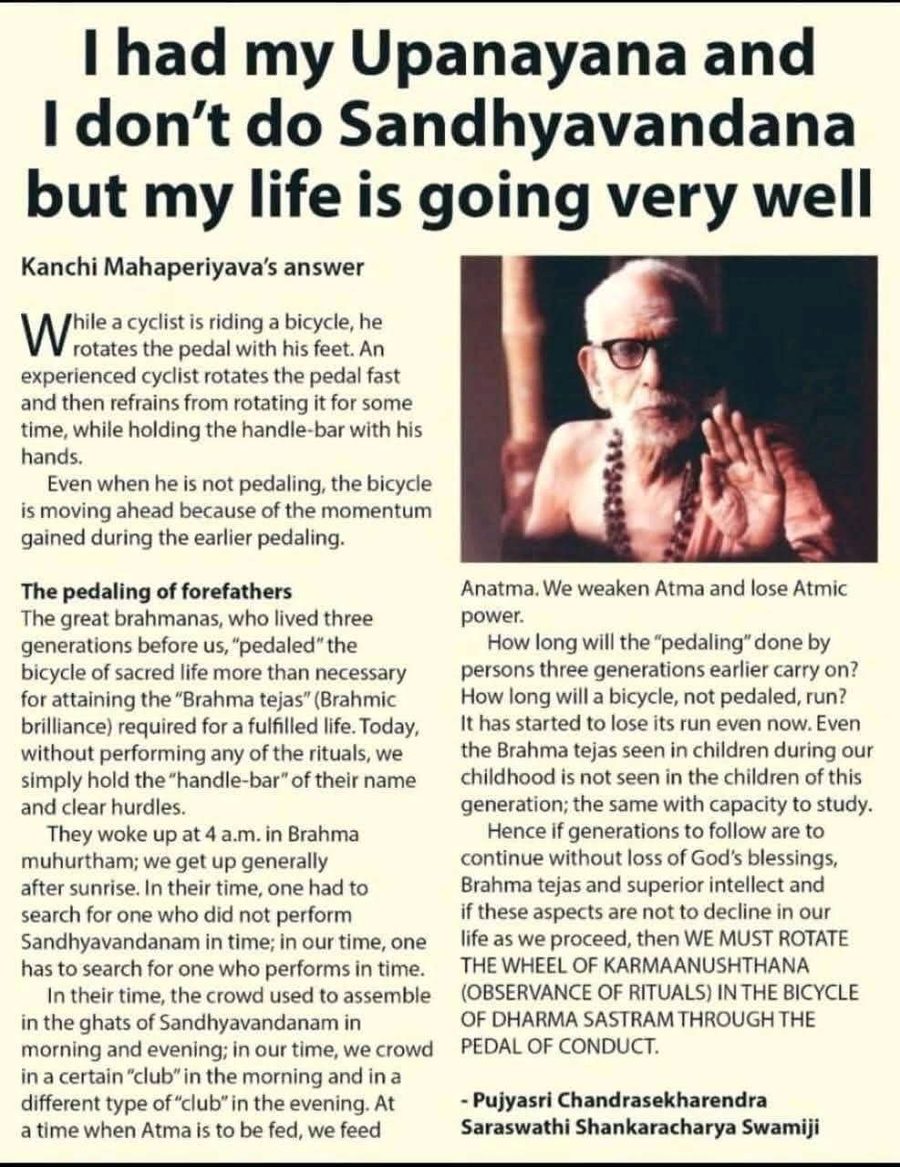
There is a second objection, quite different from having no time, and harder to answer: I had my upanayana, I do not perform sandhyāvandanam, and nothing has gone wrong. It is not said in defiance. It is usually said with genuine puzzlement, because it is true.
The answer given by Kanchi Mahaperiyava is the finest thing anyone has said about it, and it grants the premise entirely before turning it over.
“While a cyclist is riding a bicycle, he rotates the pedal with his feet. An experienced cyclist rotates the pedal fast and then refrains from rotating it for some time, while holding the handle-bar with his hands. Even when he is not pedaling, the bicycle is moving ahead because of the momentum gained during the earlier pedaling.”
Pujyasri Chandrasekharendra Saraswathi Swamiji of Kanchi
You are not wrong that the bicycle is moving. You are wrong about what is moving it.
“The great brahmanas who lived three generations before us pedaled the bicycle of sacred life more than necessary for attaining the Brahma tejas required for a fulfilled life. Today, without performing any of the rituals, we simply hold the handle-bar of their name and clear hurdles.”
Then the observation that settles it, and which anyone over fifty will recognise:
“They woke up at 4 a.m. in Brahma muhurtham; we get up generally after sunrise. In their time, one had to search for one who did not perform sandhyāvandanam in time; in our time, one has to search for one who performs in time.”
And so the question that the whole analogy exists to ask:
“How long will the pedaling done by persons three generations earlier carry on? How long will a bicycle, not pedaled, run? It has started to lose its run even now.”
What makes this argument unusual is that it does not threaten anybody. It does not say your life will fall apart if you stop. It says something more uncomfortable and more likely: that your life is going well on borrowed momentum, that the loan is finite, and that the people who will find the account empty are not you.
The same point is made elsewhere as an inheritance that is being spent rather than earned. It is the argument for a nitya karma stated in the only terms that really land — not what you gain by doing it, but what quietly stops arriving when nobody does.
On this quotation. The English rendering above is the one that circulates widely, attributed to Pujyasri Chandrasekharendra Saraswathi Swamiji of the Kanchi Kamakoti Peetham. We have not been able to trace it to a specific volume of Deivathin Kural or to another primary publication, and say so rather than manufacture a citation; note also that his successor is recorded as having often repeated the same cycle-pedal example. If you can point to the original discourse, please write and this note will be replaced by a proper reference.
Kanchi Kamakoti Peetham, not Sringeri. This site follows Sringeri where authorities differ; this is not such a case, but the attribution should not be blurred.