The pañcāṅga and the saṃkalpa for where you are standing — reckoned from your own sunrise, in your own language.
Free. No account needed for the pañcāṅga or the saṃkalpa.
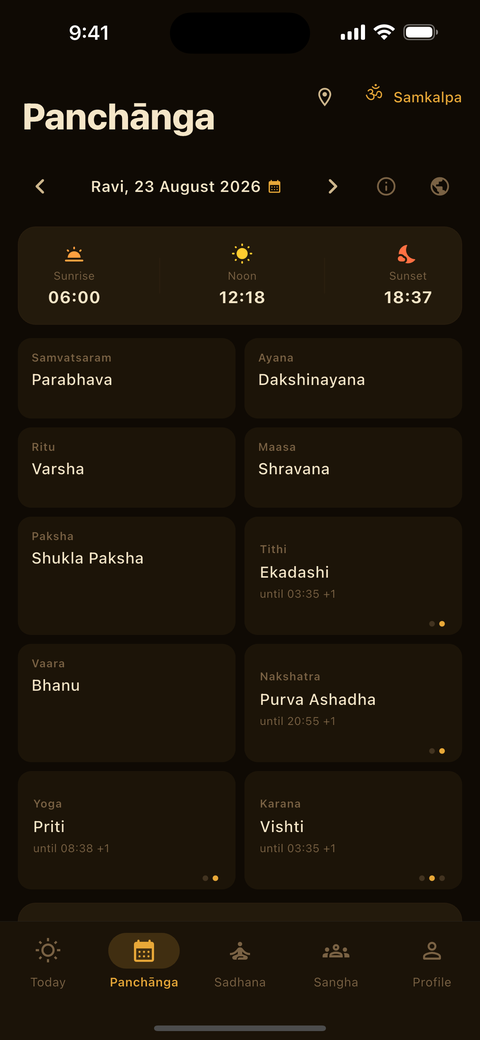
Tithi, nakṣatra, yoga and karaṇa as published by Śrī Śāradā Pīṭham, Sringeri — every element of the day, not just the one at sunrise.
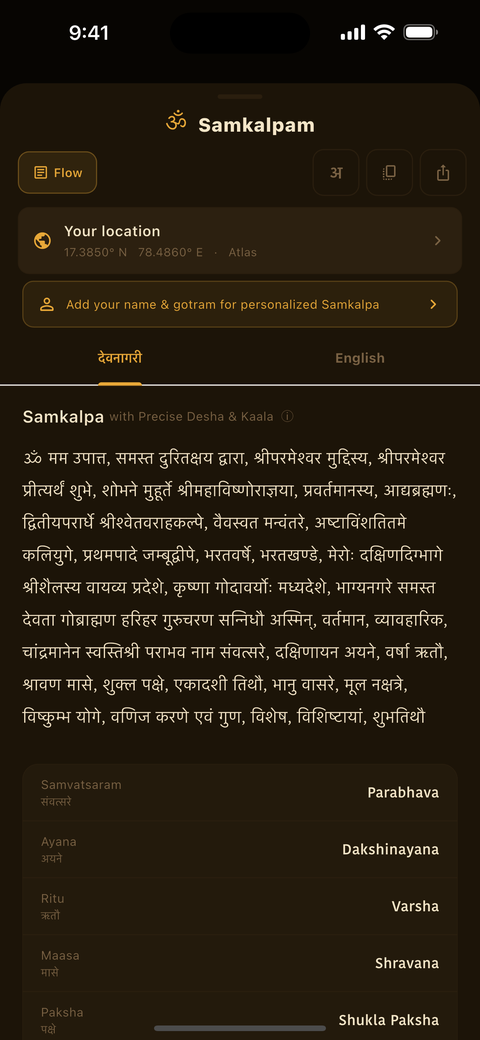
कृष्णा गोदावर्योः मध्यदेशे
The dvīpa, the kṣetra, the rivers you stand between and the name of your city — from real geography, not a template.
Uttama, madhyama and adhama kāla computed for your own latitude, so you know not just that it is time but which time it is.
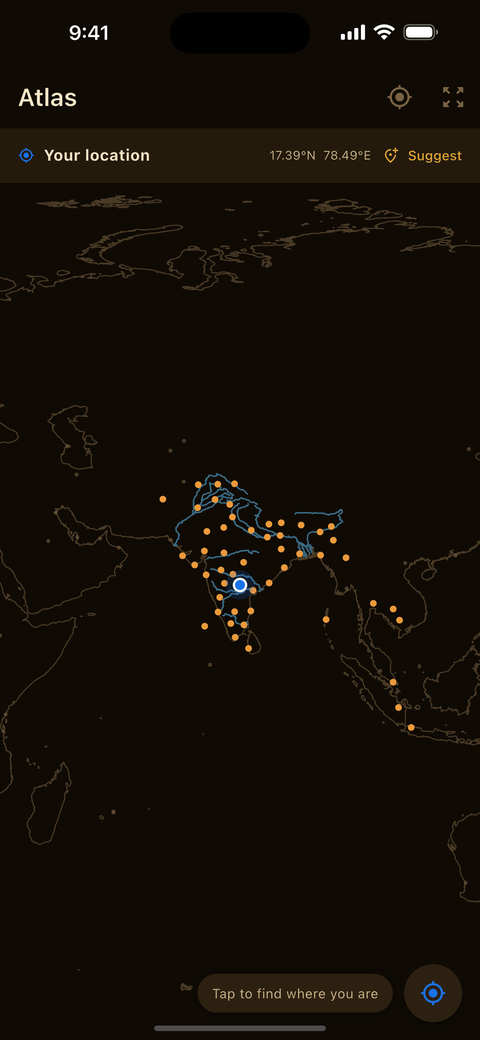
Every place the app can name in Sanskrit, with the rivers drawn along their real courses.
Read and recite in your own script, or in Devanāgarī, or in Roman.
Everything is computed on your device. Your location never leaves it.
“There is time every day to watch television, time for a morning walk, time to read the newspaper, time to chat with friends — hours together for all of these. And no time for the daily sandhyopāsana? … At the very least, perform sandhyāvandanam for ten minutes and then go about your work. Do not abandon it.”
Jagadguru Sri Sri Sri Bharati Tirtha Mahaswamiji of Sringeri, as recorded in the KCDT Sandhyavandanam Q&A, which adds: this is not the Jagadguru's word but His command.
Sandhi is a joint — the seam where night meets day and day meets night. Sandhyā is what is born at that seam, and sandhyāvandanam is what is done there. Vyāsa Smṛti puts it plainly:
उपास्ते सन्धिवेलायां निशायां दिवसस्य वा ।
तामेव सन्ध्यां तस्मात्तु प्रवदन्ति मनीषिणः ॥
“Because it is worshipped at the joining time, of night and of day, the wise call that very thing sandhyā.”
The sun is the one deity nobody has to take on trust — the pratyakṣa devatā, visible every morning. Everything that keeps us alive comes from it. As one modern writer on the subject puts it, we eat sun, we breathe sun, and we wear sun. Sandhyāvandanam is, before anything else, the act of turning to that source three times a day and offering it water in both hands. The tradition is blunt about the alternative: elders say one should not so much as look at the face of an ingrate.
A nitya karma is not an observance undertaken when one feels moved. It is a daily obligation, and the śāstras are severe about dropping it — sandhyāhīno'śucir nityam anarhaḥ sarvakarmasu: one without sandhyā is perpetually impure and unfit for every other rite, and whatever else he performs bears him no fruit. The Kūrma Purāṇa says the twice-born who exerts himself in other pious works while abandoning the sandhyā salutation goes to a myriad hells.
The positive form of the same point is more useful: sandhyāvandanam does not so much add merit as make the rest of one's practice capable of bearing fruit. Abhiṣeka, sahasranāma, vrata — performed by one who has skipped the sandhyā, they are held to be not merely fruitless but a fault.
An education officer once put that question to the Jagadguru of Sringeri and would not let go of it — is it the burning orb, a devatā, Hiraṇyagarbha, Īśvara, or Brahman? The answer is worth the whole conversation:
“The upāsya is ever one, but its exact nature varies with the competence of the worshipping aspirant. … The nature of the worshipped necessarily depends upon the nature of the worshipper.”
Jagadguru Sri Chandrashekhara Bharati Mahaswamiji of Sringeri, in The Sandhyā Worship
Which is to say: begin. The rite does not wait on your having settled what it means.
The sequence varies a little by śākhā and by sūtra — the practical rule given by every authority is to follow what your own elders and ācārya hand you. In outline:
If you must shorten it, the three that carry the rite are arghya-pradāna, gāyatrī japa and sūryopasthāna. Reducing the prāṇāyāma and leaving out the mudrās, ten gāyatrī will bring it inside ten or twelve minutes. The sources permit this under pressure and are equally clear that it should not become the daily habit — as one puts it, an answer written in a hundred words where two hundred were asked will not carry full marks.
The day from sunrise to sunset is thirty ghaṭis of twenty-four minutes each, in five parts of six: prātaḥ, saṅgava, mādhyāhna, aparāhṇa and sāyaṃ. The sandhyās belong to the first, third and fifth. Within each, three grades:
| Prātaḥ | uttama while the stars are still visible · madhyama once they have gone but before sunrise · adhama after the sun is up. Devī Bhāgavatam 11.16.4 |
|---|---|
| Mādhyāhnika | uttama at mādhyāhna proper · madhyama in the saṅgava kāla before it · adhama in the aparāhṇa after. |
| Sāyaṃ | uttama while the sun is still visible · madhyama after it has set but before the stars · adhama once the stars are out. Devī Bhāgavatam 11.16.5 |
The morning window runs from two ghaṭis — 48 minutes — before sunrise, and the evening window for 72 minutes after sunset, as published by Sringeri in Sandhya Kala Mayukha. That is what this app computes. Other compilations divide it differently — one widely circulated set of rules treats only the first ghaṭi before sunrise as uttama and prescribes a prāyaścitta arghya beyond the second. Where authorities differ, this app and this site follow Sringeri.
Because these windows are measured from your own sunrise, they move with your latitude and the season — which is what the app is for. See the sources for everything cited here.
This is the question the Jagadguru answered above, and he did not accept it. Ten minutes, then go to work. The compilations add the practical form: reduce the prāṇāyāma, leave the mudrās, ten gāyatrī, and you are done in ten to twelve minutes.
Yes, and the sources treat this as the ordinary case rather than a scandal. Omission has a prescribed prāyaścitta, which your ācārya will give you; for a long lapse the guidance is to resume under a teacher rather than to calculate. Begin.
No. The teaching camps that produced these Q&A documents report students from eight years old to eighty. As one answer puts it, in English, better late than never.
The standard reply is the driving lesson: the first day at the wheel feels the same way, and today there is hardly a person who cannot drive. Ten days of practice and you will say it is easy. Learn it from a teacher rather than a book or a video — the mantras are svara-bound, and the hand-placements are shown, not read.
Travel is no exemption: bathe where you can, keep the articles with you, and perform it — the compilations describe doing so on train platforms and in airport prayer rooms. In illness, do what you are able, even mentally; where one is genuinely incapable, a father, son, brother or pupil may perform it on one's behalf with the appropriate saṃkalpa. Where water is unavailable, mental performance is allowed. What is not allowed is abandoning it.
Not directly, on the usual account — it destroys the sins accumulated since the previous sandhyā, and it makes one's other observances capable of bearing fruit. What it is said to bring is longevity, clarity, and brahmavarcas: āyuḥ prajñāṃ dhanam.
The tradition grades it: performed at home it carries its own measure; at a riverbank ten times that, in a gośāla a hundred, in a yāgaśāla a thousand, and at a tīrtha or siddhakṣetra without limit. But the home is where the daily rite is actually kept, and that is what counts.
Sringeri's. Tithi, nakṣatra, yoga, karaṇa and the festival days are read from what Śrī Śāradā Pīṭham publishes rather than computed independently and then disagreeing with it. Beyond the published range the app falls back to a Sūrya-Siddhānta calculation and says so.
Sandhyopāsana with the Gāyatrī is prescribed for the twice-born after upanayana. On who may perform what, and with which mantras, follow your own ācārya — the app takes no position and simply computes the times and the saṃkalpa.
No.
Sandhya Vandanam is in beta on iOS while the App Store listing is prepared.
You will be added to TestFlight and can install it straight away.
Android is not ready yet. The app is built and running on Android; the Play listing is still being prepared.
One message when it reaches Play, and nothing else.
In beta on iOS while the App Store listing is prepared. Android is built and running, with the Play listing to follow.
Or write to medury@gmail.com.